
Fortress of Arad
18th-century Habsburg fortress on the former Ottoman border.
The Fortress of Arad was constructed on the left bank of the Mureș River in the 18th century, ordered directly by Habsburg Queen Maria Theresa. Located in what is now the Subcetate neighborhood of Arad, Romania, it once marked the military frontier between the Habsburg and Ottoman Empires. Its strategic importance grew after the city was freed from Ottoman rule following Habsburg victories at the Battles of Vienna and Mohács, and the subsequent Treaty of Karlowitz placed Arad on the empire’s border. Prince Eugene of Savoy initially proposed rebuilding an older Turkish fort on the river’s right bank, but after consulting the Empress, the decision was made to construct an entirely new complex on a peninsula south of the city. Building began in 1763 and ended in 1783, using thousands of prisoners and costing 3 million florins.
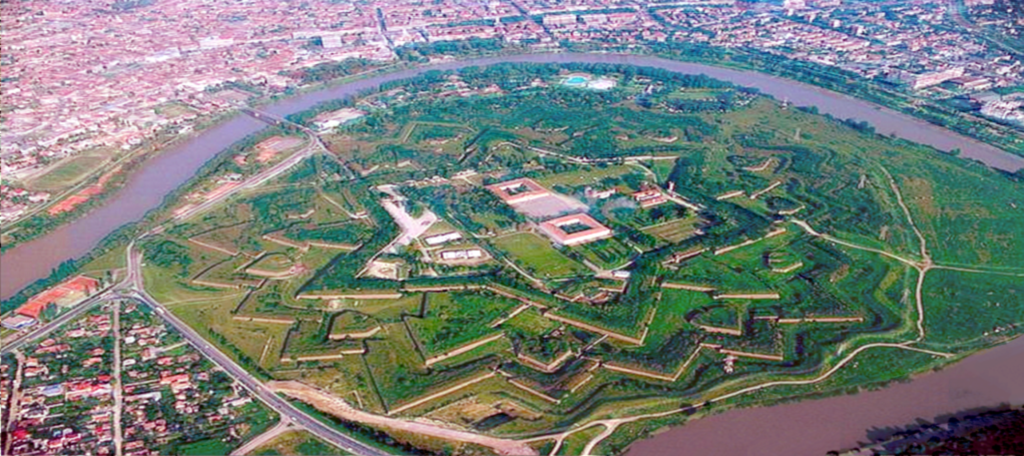
The fortress was designed by Austrian general and architect Ferdinand Philipp von Harsch. It follows the Vauban style, shaped like a six-pointed star with three rows of brick walls, each 3 meters thick, filled with earth and containing casemates and underground bunkers. Floodable trenches and a moat fed by the Mureș River surrounded the structure, bordered by an earth glacis. The walls stretched 3,180 meters in circumference, with long curtain walls arranged in a tenaille system. Six bastions provided 296 gunholes, flanked by lunettes and ravelins. The main gate and interior buildings are Baroque in style. Inside, a Catholic church once housed Franciscan friars under the patronage of St. John of Capistrano; the last four monks left in 1861, when the church became a military hospital. Today, the church and its adjacent buildings are derelict. The barracks could normally hold 2,940 soldiers, but capacity could rise to 4,030.
After completion, the fortress formed part of an inner defensive line protecting the empire’s outer regions, alongside fortifications at Oradea and Timișoara. It served as a military prison from 1794, holding 1,200 French soldiers. During the 1848–1849 Hungarian Revolution, the fortress was besieged by the Hungarian Republican army for nine months before falling in June 1849. Just 46 days later, the Habsburg army retook it and used it as a prison for over 500 officers, most sentenced to death. On 6 October, 13 generals of the Republican Army were executed outside the east walls; they are now considered martyrs. Empero
- Built
- 1763–1783
- Location
- Arad, today Romania (formerly Kingdom of Hungary)
- Architect
- Ferdinand Philipp von Harsch
- Style
- Vauban-style bastion fortress
- Cost
- 3 million florins
- Circumference
- 3,180 m (10,430 ft)
- Capacity
- 2,940 to 4,030 soldiers
Lore & Background
Following the victories of the Holy League at the Battle of Vienna and the Habsburg victory at the second Battle of Mohács, the city of Arad was freed from Ottoman rule. After the Treaty of Karlowitz, the entire city was on the border region of the Habsburg Empire, becoming a focal point of the Military Frontier administration until 1751. Prince Eugene of Savoy initially planned to rebuild the old Turkish fortress on the right bank, but after consultations with Empress Maria Theresa, a new fortified complex was erected on a peninsula south of the city. Construction lasted from 1763 to 1783, using thousands of prisoners and costing 3 million florins.
The fortress was designed by Austrian general and architect Ferdinand Philipp von Harsch in the Vauban style, with a star shape of six corners, three rows of 3-meter-thick brick walls filled with earth, casemates, underground bunkers, and flooded trenches. It was surrounded by a moat fed by the Mureș River and an outer earth glacis. Inside, a Catholic church housed Franciscan friars under the patronage of St. John of Capistrano until 1861, when the church became a military hospital. The main gate and interior buildings were built in the Baroque style.
After completion, the fortress was part of an inner system of fortifications protecting the empire's outer regions, alongside Oradea and Timișoara. It was used as a military prison starting in 1794, holding 1,200 French soldiers. During the 1848–1849 Hungarian Revolution, it was besieged for nine months by the Hungarian Republican army until occupied in June 1849. After 46 days, the Habsburg army retook it and imprisoned over 500 officers, many sentenced to death, including the 13 Generals of the Republican Army executed on 6 October outside the east walls. Emperor Franz Joseph I visited in 1852 and ordered pardons. The Romanian revolutionary Eftimie Murgu was also imprisoned there.
Reader's Guide
The Fortress of Arad holds significance as a key Habsburg military installation on the former Ottoman frontier, reflecting 18th-century imperial defense strategies. Its construction under Maria Theresa and design by Ferdinand Philipp von Harsch exemplify the Vauban fortification style adapted to the region's strategic needs. The fortress played a central role in the 1848–1849 Hungarian Revolution, notably as the site of the execution of the 13 Hungarian generals, who are considered martyrs. During World War I, it was used as an improvised camp for thousands of Serb soldiers and civilians from Bosnia-Herzegovina, with 4,317 dying from typhus and maltreatment, commemorated by a plaque. The most famous prisoner was Gavrilo Princip, whose assassination of Archduke Franz Ferdinand triggered World War I. After the war, the fortress was occupied by Serbian and French troops before being handed to the Romanian Army in 1919. In the interwar period, it housed the 93rd Infantry Regiment. Following World War II, it was occupied by Soviet Red Army tank units until 1958. Today, it serves as headquarters for the Romanian 191st Infantry Battalion and hosts a mixed Romanian-Hungarian peacekeeping battalion since 1999, demonstrating its continued military relevance.
Did You Know?
- The fortress was built at the direct order of Habsburg Queen Maria Theresa, with construction lasting from 1763 to 1783.
- It was designed by Austrian general and architect Ferdinand Philipp von Harsch in the Vauban style, with six bastions and 296 gunholes.
- The 13 Generals of the Hungarian Republican Army were executed outside the fortress's east walls on 6 October after the 1848–1849 revolution.
- Gavrilo Princip, who assassinated Archduke Franz Ferdinand, was the most famous prisoner held in the fortress.
Strategic Origins & the Great Construction
The Fortress of Arad was born from the geopolitical urgency of the early eighteenth century. Following the Treaty of Karlowitz, the city of Arad sat squarely on the frontier between the Habsburg Empire and the Ottoman realm, making it a linchpin of imperial defence and the administrative heart of the Military Frontier until 1751. Recognising its strategic value, Prince Eugene of Savoy initially proposed reinforcing the older rectangular Turkish citadel on the river's right bank. Yet after deliberations with the court, Queen Maria Theresa directed a far more ambitious course: an entirely new fortified complex on a peninsula just south of the city. The resulting construction campaign stretched across two decades, from 1763 to 1783, and was carried out largely by thousands of prisoners. The total expenditure reached three million florins, a staggering sum that reflected the Habsburgs' determination to anchor their eastern border with a structure of lasting military significance.
A Star of Brick and Earth
The fortress was designed by the Austrian general and architect Ferdinand Philipp von Harsch in the celebrated Vauban tradition. Its plan took the form of a six-pointed star, with three concentric rows of brick walls each three metres thick, packed with earth for added resilience. Beneath the surface, casemates and underground bunkers provided protected firing positions, while a network of trenches could be deliberately flooded to impede attackers. The entire complex was encircled by a water-filled moat fed by the Mureș River, with an outward-sloping earth glacis beyond. The total wall circumference measured 3,180 metres, and the long curtain walls were arranged in a tenaille system. Six bastions collectively housed 296 gunholes, flanked by lunettes and ravelins for crossfire coverage. Inside, the main gate and internal buildings displayed Baroque ornamentation, and the barracks could shelter 2,940 soldiers in peacetime, swelling to 4,030 when necessary. A Catholic church dedicated to the Franciscan order under the patronage of St. John of Capistrano stood within the walls, though by 1861 it had been converted into a military hospital and today remains in a state of considerable disrepair.
A Fortress of Captivity and Tragedy
From 1794 onward, the fortress took on a darker role as a military prison. During the 1848–1849 Hungarian Revolution, it endured a nine-month siege by the Republican army before falling in June 1849. Yet Habsburg forces reoccupied it within 46 days and used it to hold more than 500 officers, most facing death sentences. On 6 October, thirteen generals of the Republican Army were executed outside the outer eastern walls and are remembered today as martyrs. Emperor Franz Joseph I visited in 1852 and granted some pardons. The Romanian revolutionary Eftimie Murgu also spent time behind its walls. The tragedy deepened during World War I, when thousands of Serb soldiers and civilians from Bosnia-Herzegovina were detained in an improvised camp outside the fort. Typhus and maltreatment claimed 4,317 lives; the dead were interred in mass graves at the Pomenirea Cemetery, commemorated by a plaque at the fortress entrance. The most notorious prisoner was Gavrilo Princip, who on 28 June 1914 killed Archduke Franz Ferdinand and Sophie in Sarajevo, an act that sparked the First World War. In 1917, Romanian deputy Ștefan Cicio Pop warned the Hungarian parliament about the inhumane conditions endured by those held within the walls.
From Habsburg Garrison to Peacekeeping Post
After completion, the fortress formed part of the Habsburg inner defensive ring alongside the fortifications at Oradea and Timișoara. Following the First World War, allied Serbian and French troops under French command occupied the site until July 1919, when it was transferred to the Romanian Army. Throughout the interwar years, it served as the garrison for the 93rd Infantry Regiment of the 1st Romanian Infantry Division. The armistice signed in Moscow on 12 September 1944 brought the city and its garrison under Soviet control, and a Red Army tank unit remained stationed there until 1958. When the Soviets withdrew, the Romanian Army reasserted its presence. Today, the fortress sits in the Subcetate neighbourhood of Arad, on the left bank of the Mureș River, in the very spot that once marked the military border between the Habsburg and Ottoman empires. It now serves as the headquarters of the Romanian 191st Infantry Battalion "Colonel Radu Golescu" and, since 1999, hosts a mixed Hungarian-Romanian peacekeeping battalion—a fitting transformation for a structure that once embodied the hard frontier between rival powers.
Gallery
Frequently Asked Questions
What is the Fortress of Arad?
It is an 18th-century Vauban-style bastion fortress sitting on the left bank of the Mureș River in present-day Arad, Romania. Commissioned by Habsburg Queen Maria Theresa and finished between 1763 and 1783, it guarded the former Habsburg-Ottoman border.
Who designed the Fortress of Arad?
Architect Ferdinand Philipp von Harsch laid out its star-shaped bastion plan in the Vauban tradition. The project cost roughly three million florins and took about two decades to complete.
What was the strategic role of the Fortress of Arad?
After the Treaty of Karlowitz pushed Arad onto the empire's southeastern frontier, the fortress was raised to block further Ottoman advances into Habsburg territory. Its 3,180-metre ring of ramparts and bastions made it one of the largest border fortifications in the kingdom.
Why is the Fortress of Arad historically important?
It physically embodied the Habsburg-Ottoman divide for much of the 18th century, following Habsburg victories at Vienna and Mohács that freed the region from Ottoman rule. Today it anchors the Subcetate neighborhood of Arad and remains a tangible link to that contested frontier era.
How does the Fortress of Arad's story end?
As the Ottoman threat receded and political borders shifted, the fortress slowly lost its defensive purpose. It now survives as a historical landmark in Arad, its ramparts and bastions still standing in the city's Subcetate district.
More in Castles in Romania 1-24
Spotted an error? Know more?
This is a living reference — every entry is fact-audited, and reader corrections feed straight into our audit queue. Suggest an edit · See this site's audit record